It is 4 AM at Barranco Camp, 3,900 metres above sea level, and the mountain is completely quiet. The climbers are asleep. The porters are asleep. The cook is asleep. Godfrey is not. He is sitting in the mess tent with a small torch, reviewing his notebook — eight pages of observations, one for each person in his group.
This is Day 4 of a seven-day Machame Route expedition. Today the group climbs the Barranco Wall. Godfrey has done it over 180 times. He is not thinking about the wall. He is thinking about John, who had a headache last night, and Peter, who went quiet yesterday afternoon, and Sarah, whose breathing was laboured on the final section of yesterday's hike. He is thinking about who needs watching, who needs encouraging, and who might need to be held back.
Climbers experience their guides as the calm, sure-footed presence at the front of the group. What happens before that — the hours of preparation, the constant quiet assessment, the decisions made before anyone else is awake — is almost entirely invisible. This is what it actually looks like.
Meet Godfrey
Godfrey is 38 years old, born and raised in Moshi at the foot of Kilimanjaro. He started as a porter at 19, became an assistant guide at 23, and earned his lead guide certification at 26. He is now one of our most senior guides, leading between 15 and 20 expeditions per year — somewhere in the region of 180 summits over his career, and counting.
He has three children and his wife Mary teaches primary school. When he is not on the mountain he coaches youth football in Moshi and tends a small coffee farm on family land. He speaks four languages on the trail: Swahili, English, enough German to calm nervous climbers, and what he calls "the language of the mountain" — reading altitude, weather and body language without words.
"People think being a guide is just walking up the mountain. They don't see the preparation, the worry, the responsibility. When I'm on Kilimanjaro, eight people's safety is on my shoulders. Their summit dreams, their health, their lives — all of this I carry every day."
— Godfrey
The Daily Schedule: Day 4 (Barranco to Karanga Camp)
Today's plan: Wake the group at 6:30 AM, breakfast at 7:00, depart by 8:00. Climb the Barranco Wall, then hike to Karanga Camp (4,035m). It's a short day by distance – only about 5 kilometers – but includes technical scrambling and critical acclimatization time.
Godfrey has been in the mess tent since 4 AM. The rest of the team — assistant guide James, cook Ally, porter supervisor Emmanuel — arrives shortly after. They review the night's health check results, today's route and timing, the afternoon weather forecast, and which climbers will need close assistance on the wall. John's headache. Peter's mood. A boot sole that started separating yesterday and needs watching.
This briefing happens every single morning, regardless of how routine the day looks. Godfrey and James have done over 80 expeditions together. They still go through everything formally. On a mountain, assumptions are how things go wrong.
While the cook team prepares breakfast, Godfrey reviews his notebook. Every climber has a page. He tracks what they ate, how much they drank, their oxygen saturation readings, sleep quality, mood, pace — anything that might matter later. Three examples from yesterday:
"John (USA, 52): Strong yesterday. Eating well. Slight headache at night — resolved with paracetamol. Watch hydration — only drank 2L yesterday, needs 3–4L."
"Sarah (Netherlands, 34): Breathing laboured on hills. Normal for altitude. Good spirits. Full dinner. No concerns."
"Peter (Germany, 45): Quiet yesterday afternoon. Asked twice how much further to camp. Possible altitude blues. Monitor mood today. Partner Anna is strong — keep them together."
Eight climbers, eight pages, updated every evening. These notes determine who gets a word of encouragement this morning, who gets watched more closely on the wall, and who might need a quiet conversation tonight.
"A good guide knows every person in the group. Not just their name – I know their breathing pattern, their walking rhythm, their mood changes. I can tell when someone is struggling before they say anything. This is how we keep people safe."
— Godfrey
James does the tent-to-tent wake-up calls, but Godfrey is already at the edge of the mess tent, watching. As climbers emerge, blinking in the early light, he is reading them — stiffness in the gait, colour in the face, whether they look for company or retreat into themselves. Most of what a guide does is invisible to the people being guided.
John comes out looking rough. "How was your night?" Godfrey asks. "Terrible. Barely slept. Headache is back."
Godfrey checks his oxygen saturation — 89%, low but acceptable at 3,900 metres. The headache is mild, John's coordination is fine, he's tracking the conversation clearly. Decision: continue, but move him to the front of the watch list. This is textbook mild altitude sickness at this elevation. The answer isn't descent — it's careful monitoring and today's acclimatization walk, which will almost certainly help.
Breakfast is porridge, eggs, toast, coffee, tea. Godfrey sits with the group but he is not really eating — he is watching who eats what and how much. John takes tiny portions. "You need to eat," Godfrey says, quietly enough that only John can hear. "Your body is burning 4,000 calories today. Small portions every hour — that's fine. But we start now."
At altitude, appetite disappears. It's one of the most consistent and most dangerous effects of being high on the mountain. Godfrey has learned when to push and when to accept small victories. John eats half the porridge and a piece of toast. Godfrey moves on.
The morning briefing is short: today's route, the wall ahead, the pace, the hydration target. "Pole pole. Always pole pole." And then they walk.
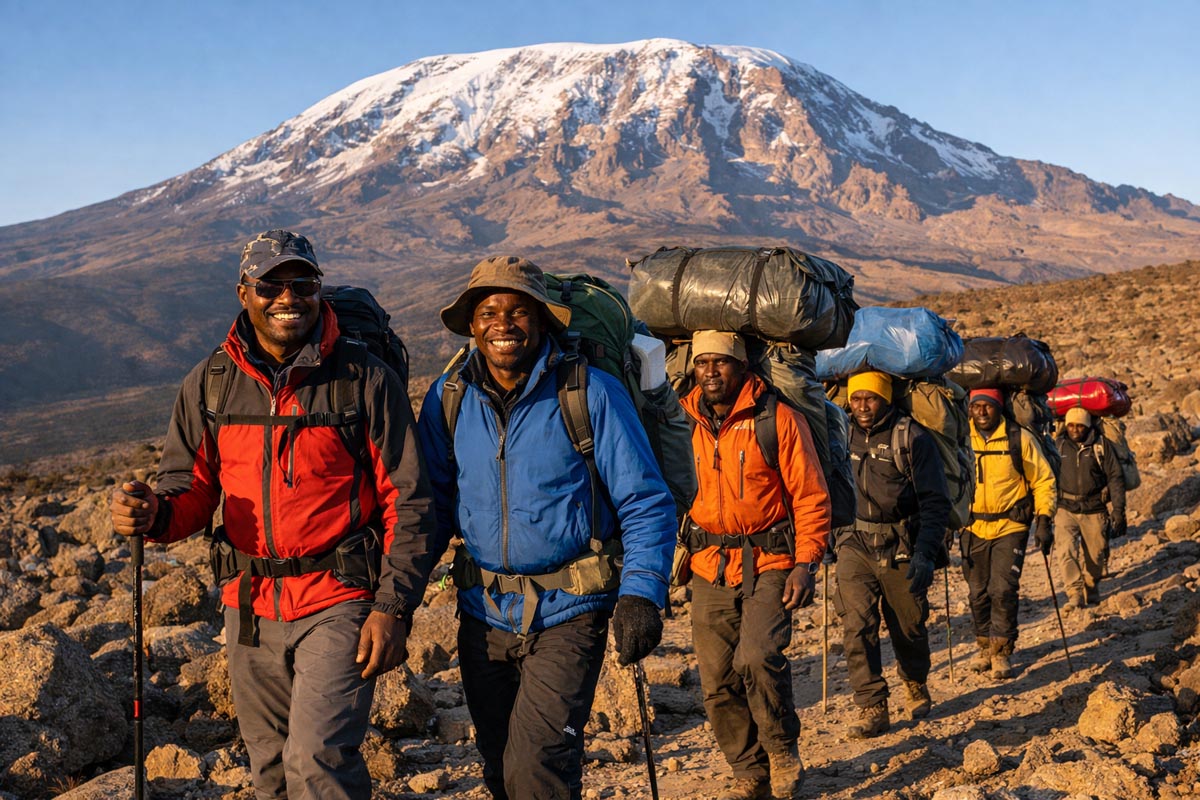
Godfrey leads. James brings up the rear — his job is to make sure no one falls behind unnoticed and to catch small problems before they become large ones. The pace is deliberately slow, slower than most people's instinct on a fresh morning. Some climbers try to speed up. "Too fast," Godfrey calls back, without turning around. "We walk together. The mountain is not going anywhere."
Pace control is one of the most consequential things a guide does. Too fast and the body accumulates altitude debt faster than it can manage; too slow and the cold sets in. The right pace is a narrow band that Godfrey has spent twelve years learning to find and hold.
💡 What Guides Watch While Walking
Godfrey is scanning his group continuously: breathing patterns, gait, whether they can hold a conversation, the colour of their faces, small changes in behaviour. Most of what he notices never becomes a problem. But catching the early signals is what prevents the late ones.
Godfrey stops the group at the base and explains what's ahead: they go one by one, he leads the route, hands and feet, no rushing. He assigns positions based on his notebook — strong climbers first, nervous ones in the middle where he and James can assist from above and below. Peter and Anna stay together.
Halfway up, Sarah freezes. "I can't do this," she says, voice tight.
Godfrey descends back to her position — not in a hurry, not making it a bigger moment than it needs to be. "Look at me. Not down. At me. Good. Your right foot goes on that rock. Yes. Left hand on that hold. Perfect. One move at a time."
It takes twenty minutes. The rest of the group waits above, quietly. They have all had their moment on this wall.
At the top, Sarah is shaking and smiling. "I can't believe I did that." Godfrey grins. "I never doubted."
The porters have raced ahead — they always do — and lunch is already set up: hot soup, sandwiches, fruit, tea. Godfrey moves quietly through the group. "How are you feeling? Any headache? Show me your bottle."
John's oxygen saturation is at 91% — up from 89% this morning. The morning's climbing has helped. "Your body is adapting," Godfrey tells him. "Tomorrow you feel better. I promise."
It's a promise Godfrey has made many times on this mountain. It's one he's learned to trust.
The group arrives at Karanga Camp by early afternoon. The porter team has been here long enough that the tents are up and the water is already boiling. Godfrey's afternoon runs continuously — tent inspection, individual health checks, team debrief, tomorrow's route review, equipment check, weather assessment. Between all of it he is answering questions, helping someone with a blister, explaining what Barafu will feel like, and spending time with Peter, who is still struggling.
The afternoon also involves coordinating with other guide teams on the mountain by radio. Kilimanjaro has multiple expeditions on it at any time, and guides share information — weather changes, trail conditions, anything that might affect a group's safety or timing.
Dinner is soup, rice, vegetables, chicken. John manages a full plate — Godfrey notices and says nothing, but makes a note. After dinner, everyone gathers in the mess tent for the evening briefing.
"Today was good. You climbed the Barranco Wall — the most technical section of the entire route. Everything from here is walking. You should feel proud."
He pauses, making eye contact with each person in turn.
"Tomorrow we go to Barafu Camp. It's not far, but it's higher than you've slept before. You might feel worse than today. This is normal and it's temporary. We rest in the afternoon, sleep early, and at 11 PM we start for the summit."
"Summit night is hard. Very hard. But you have been preparing for six days. Trust the process. Trust yourselves. Trust me."
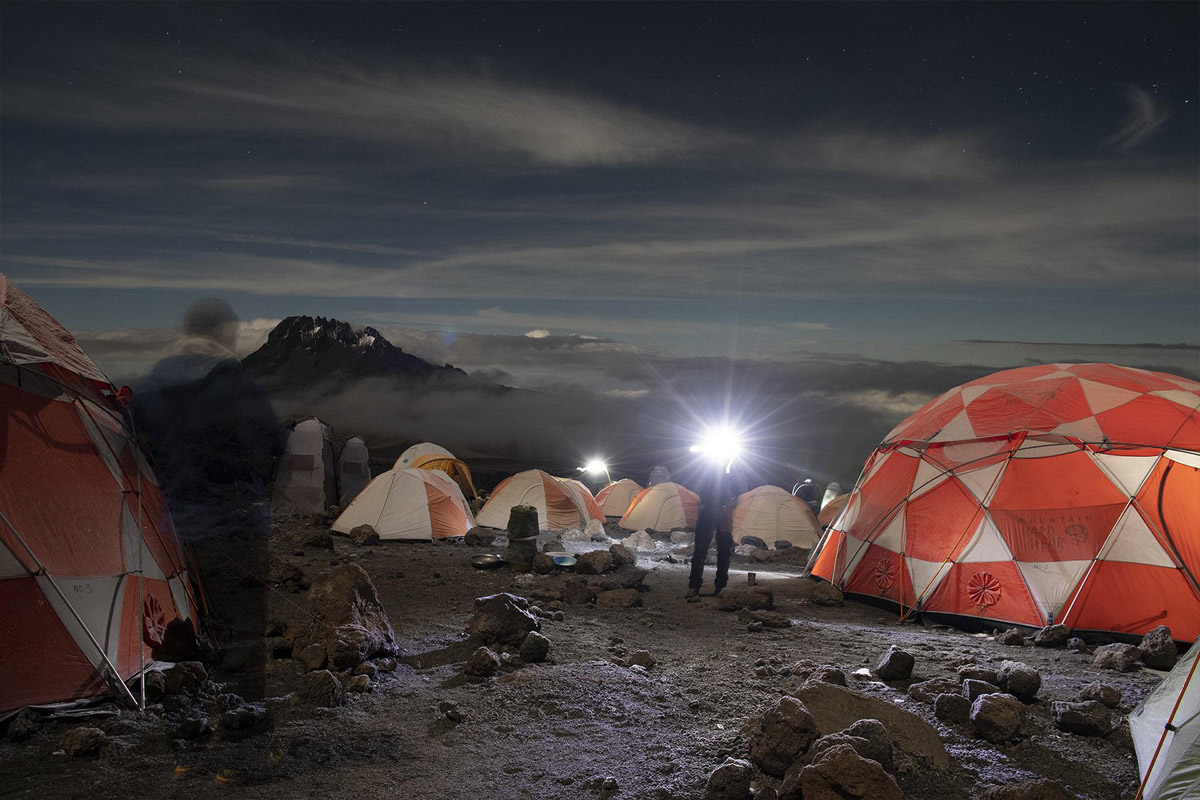
Before the climbers sleep, Godfrey does one last round of tents. Not a health check — that was done at 2 PM. This is something quieter. He knocks, asks how people are feeling about tomorrow, listens more than he speaks.
At Peter and Anna's tent: "How are you feeling about the summit?"
Peter admits he's nervous. The altitude has been harder than he expected. He's not sure he'll make it.
Godfrey sits down outside the tent. "Listen to me. You have already done the hardest part. You climbed the Barranco Wall today. You pushed through Day 3 when you felt bad. I have watched you for five days. I know what you're capable of better than you do right now." He pauses. "Do you trust me?"
Peter nods.
"Then trust me when I tell you: you will summit."
The camp is quiet. Godfrey sits in the mess tent with James for a while, reviewing notes for tomorrow. John's improving numbers. Peter's state of mind. Sarah's confidence after the wall.
"The group is strong," James says. "Everyone will summit."
"Maybe," Godfrey says. "Altitude is unpredictable. But yes. I think we get everyone up."
He radios the base office in Moshi — all on schedule, weather holding — and then goes to his tent. He won't sleep deeply. Guides never do on the mountain. Part of his mind stays alert through the night, listening for anything that shouldn't be there.
But lying in his sleeping bag, listening to the wind, Godfrey allows himself a brief, quiet satisfaction. Everyone is safe. Everyone is stronger than they were this morning. Tomorrow is Barafu and then the summit. Two more days of this — the weight of it, and the privilege.
This is why he does it.
What Most Climbers Don't Realize
A Kilimanjaro guide is, depending on the moment: a medical monitor reading oxygen levels and tracking symptoms across eight people simultaneously; a psychologist managing group dynamics and individual doubt; a coach who knows when to push and when to hold back; a logistics coordinator responsible for a team of twenty-plus porters; and a safety officer making decisions that can have life-or-death consequences. All of this while maintaining the calm, unhurried presence that the climbers in front of him need to see.
Godfrey does this eight to nine days per expedition, fifteen to twenty expeditions per year. He sleeps at altitude repeatedly, which the body never fully gets used to. He is away from his family for a significant part of every year. And every time a climber stands at Uhuru Peak, it matters to him — not as a professional metric, but personally.
"When you summit, it is your achievement. You climbed the mountain. But for me, your summit is also my achievement. Every person I bring safely to Uhuru Peak and back down – this is my summit. I have done this route 180 times. But it never gets old. Because every time, I help someone achieve their dream."
— Godfrey
Back in Moshi
When the expedition ends and the group has flown home, Godfrey takes the bus back to Moshi. One day with his family. One day on the coffee farm. One day checking equipment and reviewing notes for the next group. Then he goes back up.
After four expeditions in a row he takes a two-week break — time to sleep at 900 metres where the air is thick, to be fully present with his children, to remember what it feels like to not be responsible for anyone but himself. And then, when the two weeks are up, he packs his bag and heads back to the mountain.
Not because he has to. Because this is who he is.
About Our Guide Teams
Expedition Kilimanjaro has worked with the same core guide teams since 2008. Our senior guides hold Wilderness First Responder certification, Tanzania national park guide licences, and a minimum of ten years' experience on the Machame Route specifically. They are not interchangeable hired hands — they are the people who make every expedition work, and we have built our programme around them.
Tanzanian law requires that all guides and porters on Kilimanjaro are Tanzanian nationals. We support the Tanzania Porters Association and the Tanzania Women Guides Foundation, because the mountain and the people who live at its foot are inseparable.